|
| |
 |
| |
Shreis Scalene Sciences
11516 Darnestown Rd. Gaithersburg,MD 20878
Tel : (001)301-926-0566
Fax : (001)301-926-2925
email : Shréis.com
|
|
|
 |
|
|
|
 |
Osteo-Arthritis
and RFQMR
New non-surgical Osteo-arthritis
treatment
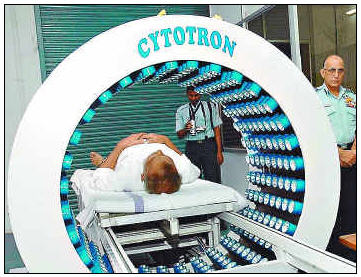
Now knee joint cartilage can be regenerated and repaired by QMR
based Tissue Engineering with Cytotron Therapy. QMR regenerates
degenerated cartilage and relieves chronic pain and disability of
Knee non-invasively with multi-frequency rotating quantum
electromagnetic resonating beams. Many knees can be saved from knee
replacement surgery.
What is the mechanism of
Quantum Magnetic Resonance (QMR) Tissue Engineering (Regeneration
and Degeneration)?
QMR produces high power multi frequency rotating quantum
electromagnetic resonating beams that can be 'focussed ' on the site
required to be treated.
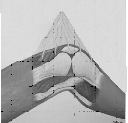 What
is the Principle of QMR in Tissue Regeneration and Degeneration? What
is the Principle of QMR in Tissue Regeneration and Degeneration?
Rotational Field Quantum Magnetic Resonance (RFQMR) technology
utilized highly complex quantum electromagnetic beams in the
sub-radio and near-radio frequency spectrum. The beams are precisely
controlled and focused onto tissues to alter the proton spin inside
and outside the cells therein generating streaming voltage
potentials. This alters cell membrane potential and "Jams"
the "Command and Control" of the target tissue cells
stimulating cartilage growth.
How does QMR work in Tissue Regeneration of the cartilage?
Like other tissues, bone and cartilage are constantly being built up
and broken down by a variety of metabolic and physical influences.
The major stimulus for bone and cartilage formation is a signal
generated when these structures are subjected to tension or
compression. This explains why bone atrophies in the absence of any
significant pressure, such as weightlessness during space travel or
immobilization in a cast. The transmission of this signal is also
impaired following joint injury due to trauma or diseases such as
Osteo-arthritis.
In other words, when you take a step, putting weight on the joint,
the cartilage is compressed, the fluid gets displaced, and it
carries with it mobile ions, the sodium ions, leaving behind the
negatively charged proteoglycan carboxyl and sulfate ions. This
generates an electric potential because you have
"neutralized" negative charges. This is called a streaming
potential.
QMR is designed to characterize and reproduce the required signal
that initiates these regenerative activities even though they are at
rest). by the induction of a spin in the hydrogen atoms thus
creating a streaming potential in the extra cellular matrix (ECM)
when bone or cartilage are placed under a load.
What are the results of the
treated?
As reported in the Journal of the Indian Society of Aerospace
Medicine by Wg Cdr VG Vasishta, Dr RV Kumar, and Surg Cdr LJ Pinto
evaluation of Osteo-arthritis patients treated with QMR. Using the
Knee Society Scoring System and dynamometry. there was a highly
significant improvement in Pain Score, Total Knee Score, Total
Functional Score, Range of Movement and force of extension and the
improvement persisted after the treatment.
Almost all patients show subjective improvements and are out of all
pain killers by the 4th exposure. Results are seen three months post
treatment. By the end of the treatment, almost all of the patients
can walk for 1 to 5 km, without pain. About 40% can squat down on
the floor, which they could not do it earlier. Upon 30 days follow
up 95% patients are almost normalized, can climb stairs without help
Objectively, radiological evidence shows visible changes, and
graphical measurement reveled 1 to 3.5 mm growth in cartilage during
30 days follow-up.
Dynamometry showed that, the joint capacity had gone up from as less
as 5 kg before exposure to 45 kg during 30 days follow-up.
Range of Motion, Extension Lag, Flexion Contracture, Joint Stability
and Alignment were all very significantly improved when evaluated
using knee society scoring.
These patients do not need knee replacement surgery any more.
Is the treatment painful?
No, the treatment is absolutely painless. Patients can even listen
to music, see television or read during the treatment.
How is QMR therapy evaluated and what are the expected results?
- Almost all patients show improvements
- Most patients have no pain by 4th exposure.
- Almost all patients can walk for 1 to 5 km,
- 40% can squat down on the floor
- Upon 30 days follow up 95% patients are almost
normalized, can climb stairs
- X-rays / MRI shows 1 to 3.5 mm growth in cartilage
during 30 days follow-up.
- Dynamometry shows increased joint capacity from less
than 5 kg before exposure to 45 kg during 30 days follow-up.
- Range of Motion, Extension, Flexion, Joint Stability
and Alignment improve significantly when evaluated using knee
society scoring.
|
|
|




 Shréis-Scalene